
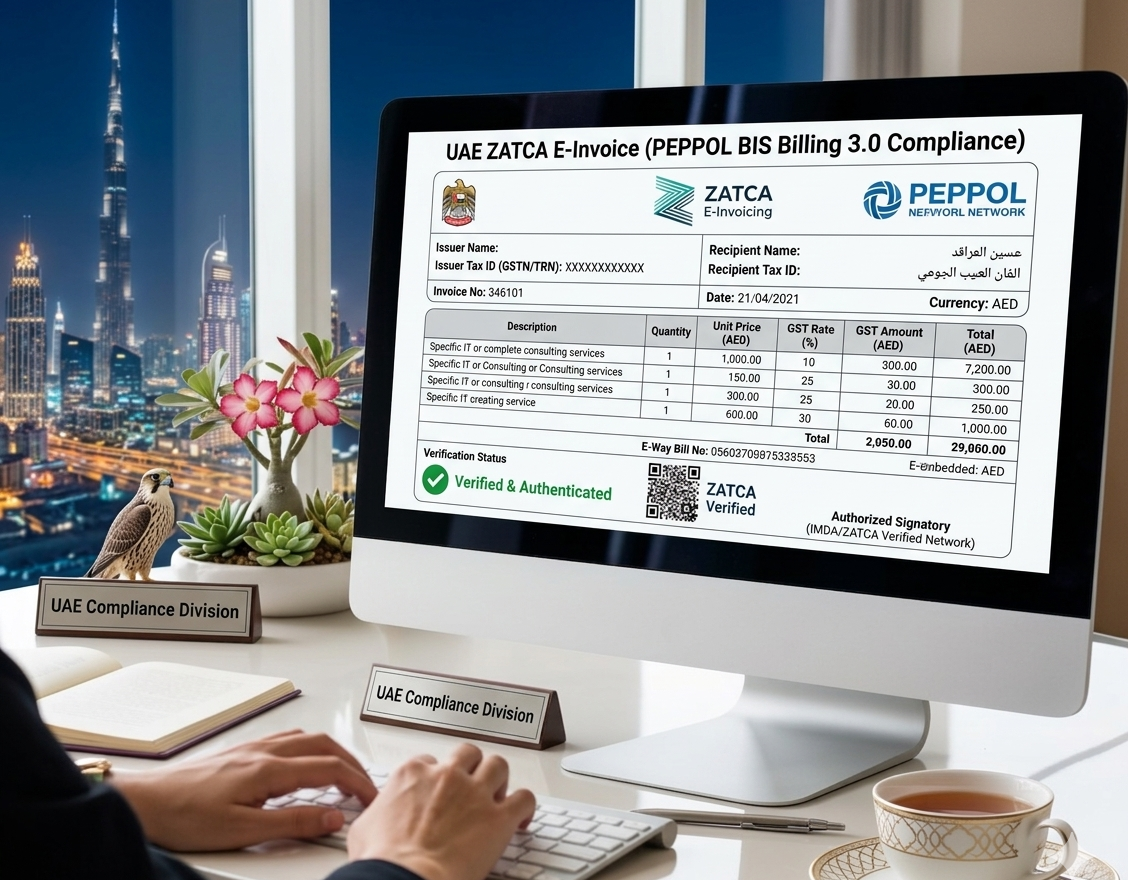
Invoicing in the UAE is changing — not gradually, but with a defined regulatory deadline and technical requirements that leave little room for improvisation. The UAE E-Invoicing System, anchored in the Federal Tax Authority’s digital agenda under Vision 2031, moves invoice exchange from bilateral PDFs to a government-validated, real-time reporting model. Phase one compliance is mandatory from 2026. For most businesses, that timeline is closer than internal planning cycles tend to suggest.
This guide addresses finance directors, compliance leads, IT heads, and senior decision-makers who need more than a summary — the actual workflow, what ERP integration demands in practice, where data quality problems typically surface, and how Advintek has built its platform to address each of these specifically.
UAE E-Invoicing System Framework for 2026
Structured on a Continuous Transaction Controls model, the UAE E-Invoicing System requires invoice data to reach an FTA-accredited platform either immediately prior to or at the moment of issuance. This is not a reporting exercise conducted after the fact — it is a live event. The invoice exists, in the regulatory sense, only once it has passed through the accredited infrastructure.
The FTA E-Invoicing UAE framework mandates specific formats: primarily PEPPOL BIS Billing 3.0 and XML. A digitally delivered PDF carries no compliance value under this model.
The data must be structured for machine processing, transmitted correctly, and routed through a registered access point. Four elements define the architecture:
- A five-corner PEPPOL model — supplier, buyer, and the FTA each connected through licensed, accredited intermediaries
- Prescribed mandatory data fields: VAT registration numbers, tax amounts, line-item detail, invoice date, and counterparty identifiers at minimum
- Phased rollout — large taxpayers enter in 2026, with SMEs following across subsequent defined phases
- Reconciliation with VAT return infrastructure, allowing validated invoice data to feed directly into periodic reporting
UAE Digital Invoicing standards carry measured alignment with GCC-wide frameworks — a deliberate design choice. For organisations with cross-border Gulf operations, compliance achieved in the UAE translates into preparedness for what neighbouring markets will eventually require.
Difference Between Traditional and UAE E-Invoicing System
The instinct among many finance teams is to treat the UAE E-Invoicing System as a format migration — swap the PDF for an XML, configure a transmission step, and proceed as before. That framing underestimates the scope of change. The differences are architectural, not cosmetic:
| Traditional Invoicing | UAE E-Invoicing System |
| Paper or PDF-based exchange | Structured XML/JSON — machine-readable |
| Manual data entry at every step | Automated capture, formatting, transmission |
| Errors surface during audits | Errors flagged at point of submission |
| No government visibility in real time | FTA validates every invoice as it is issued |
| Fragmented, incomplete audit trails | Tamper-proof digital record end to end |
Adopting Electronic Invoice UAE standards means the FTA gains transaction-level visibility as invoices are issued — not through periodic returns filed weeks later. That shift has meaningful compliance implications. VAT declarations can be cross-referenced against actual validated invoice data in near real time, which substantially reduces the gap between what is declared and what is verifiable. For well-run businesses, this is an advantage. For those relying on manual reconciliation post-period, it is a structural problem that the UAE E-Invoicing System will surface quickly.
Compliance Workflow Under UAE E-Invoicing System
Implementation planning benefits from a clear process map. The UAE E-Invoicing System follows five sequential stages — each with distinct technical and operational requirements:
- Invoice Generation: Invoices are produced in a structured, FTA-compliant format. UAE Invoice Automation tools remove manual formatting from this step — the correct schema is applied, mandatory fields are populated, and the file is prepared for transmission without human involvement at the output stage.
- Transmission to an Accredited Access Point: Invoice data is forwarded to an FTA-registered intermediary. This provider runs initial structural checks — confirming the file conforms to the required schema — before passing it for formal government validation.
- Real-Time FTA Validation: Tax registration numbers are verified, tax figures are checked for mathematical consistency, duplicate submissions are screened, and mandatory field completeness is confirmed. Invoices that pass this stage receive a unique government-issued validation identifier — without which the invoice has no legal standing.
- Delivery to the Buyer: The validated invoice reaches the buyer through their own accredited access point in the same structured format. Both parties hold an identical, government-verified record — which simplifies input tax recovery and removes ambiguity from future audit situations.
- Archiving: Retention periods follow UAE tax law requirements. Practically, validated invoice data can auto-populate VAT return fields, reducing the manual load at period close for finance teams managing high transaction volumes.
Real-Time Invoice Validation in UAE
Among the operational changes the UAE E-Invoicing System introduces, real-time validation carries the most immediate day-to-day weight. Previously, an invoice error might go undetected until an audit — months or years removed from the original transaction. Under the current framework, rejection happens at the moment of submission. Finance teams accustomed to catching errors in reconciliation must now build processes that prevent errors from reaching the submission stage at all.
The FTA validation platform applies five checks to each submitted invoice:
- Schema conformance — strict adherence to the required PEPPOL or XML structural specification
- Mandatory field completeness — VAT registration numbers, invoice date, tax amounts, and line-item data must all be present and correctly formatted
- Mathematical accuracy — VAT amounts must correspond precisely to declared base amounts and applicable rates, with no tolerance for rounding inconsistencies
- Duplicate detection — any invoice reference already submitted to the FTA platform will trigger an immediate rejection
- Counterparty verification — both supplier and buyer VAT registration numbers must be active and valid in the FTA registry at the time of submission
Rejection responses demand the same process rigour as confirmations. Error codes must be captured, mapped to the originating invoice, and routed into a defined correction workflow. Where the correction is deterministic and rules-based, it should be automated. This is not a minor implementation detail — it is the operational distinction that separates a genuine UAE Invoice Automation solution from one that merely generates the right file format.
ERP Integration with UAE E-Invoicing System
For organisations of any operational scale, the UAE E-Invoicing System must function within existing ERP and accounting infrastructure rather than alongside it. Integration is where the bulk of technical implementation effort is concentrated, and three established paths exist:
- Native ERP connectors: SAP, Oracle, and Microsoft Dynamics are each developing certified connectors for FTA E-Invoicing UAE requirements. A certified native connector is the most stable option where available — schema mapping and transmission protocols are handled natively, reducing the risk of format mismatches and versioning issues.
- Middleware solutions: For organisations with customised ERP environments where a native connector is not yet certified, a middleware layer performs the translation between internal invoice data and the FTA-required transmission format. This approach accommodates complexity at the cost of an additional dependency in the integration chain.
- Direct API integration: Organisations with established in-house development capability may build direct API connections to an accredited access point. The approach offers flexibility and lean architecture but carries ongoing technical ownership requirements.
Before integration work begins, whichever path is selected a data quality audit is not optional. The Electronic Invoice UAE framework specifies exact field formats and acceptable values. VAT registration numbers stored inconsistently across customer and supplier records will produce validation failures at go-live. Correcting master data after go-live is significantly more disruptive than addressing it beforehand. Sandbox environments are available through most accredited providers; parallel processing periods before cutover are standard practice for a reason.
How Advintek Simplifies UAE E-Invoicing System
Advintek designed its UAE E-Invoicing System platform around the FTA’s specific requirements from the ground up — not retrofitted onto a general invoicing product. The platform covers the compliance lifecycle without gaps: structured invoice generation, accredited transmission, real-time FTA validation, buyer delivery, and long-term archiving — all managed through a single environment. Regulatory updates from the FTA are absorbed at the platform level. Clients are not required to manage implementation cycles each time the technical specification changes.
Operationally, the platform delivers:
- Certified ERP connectors for SAP, Oracle, Microsoft Dynamics, and Tally — with custom API endpoints available for bespoke or legacy system environments
- Automated data mapping between existing ERP field structures and FTA-prescribed invoice fields, with implementation support to resolve data quality issues identified during the mapping process rather than at go-live
- A real-time compliance monitoring dashboard — finance and operations teams see invoice status at every stage, from generation through validation and delivery, without navigating multiple portals
- Structured exception management — validation errors are categorised automatically, routed to the appropriate correction workflow, and escalated to a human reviewer only where the correction requires judgement
- UAE Digital Invoicing scalability — platform performance is maintained at high transaction volumes, and the architecture accommodates the expanding scope of mandatory rollout phases without structural rework
Advintek’s advisory practice supports organisations at the assessment and planning stage — current-state evaluation, compliance gap analysis, data readiness review, and implementation roadmap development aligned with the FTA’s phased timeline and the organisation’s internal capacity.
Expand from UAE to Singapore with Smart e-Invoicing
As businesses in the UAE accelerate their digital transformation, expanding into Singapore’s PEPPOL-based e-invoicing ecosystem offers new opportunities for seamless and compliant transactions. Managing invoicing across these regions requires a solution that ensures automation, accuracy, and cross-border compliance. To simplify your global invoicing operations, explore Advintek e-Invoice Singapore for secure and scalable integration.
Conclusion
The UAE E-Invoicing System is a regulatory certainty with a fixed timeline and specific technical requirements. What varies between organisations is how well-prepared they are when the deadline arrives. The FTA E-Invoicing UAE framework rewards early, systematic engagement — those that begin assessment, data remediation, and integration work in advance find the transition far more manageable than those that defer. Advintek brings purpose-built technology, deep integration capability, and regulatory expertise to that process, helping businesses meet this obligation without operational disruption and with the infrastructure in place to sustain compliance as the framework continues to develop.
FAQs
Q1. Who does the UAE E-Invoicing System apply to?
All VAT-registered UAE businesses. Large taxpayers enter phase one in 2026; SMEs follow in later defined phases.
Q2. What formats are accepted under E-Invoicing UAE standards?
PEPPOL BIS Billing 3.0 and XML. Digital PDFs do not satisfy the FTA’s structured data requirement.
Q3. How does Electronic Invoice UAE validation work?
Invoices pass through an accredited access point; the FTA validates structure, fields, tax figures, and counterparty registration.
Q4. Can our existing ERP integrate with the UAE E-Invoicing System?
Yes — via native connectors, middleware, or direct API, depending on the ERP platform and customisation level.
Q5. What does UAE Invoice Automation contribute to compliance?
It automates invoice generation, formatting, transmission, and exception handling — making real-time compliance operationally sustainable at volume.